
Highlights from London’s Islamic & Indian Art Auctions
It was a busy week in London last week, as the spring sales of Islamic and Indian art delivered strong results across the board. The HALI team had the opportunity to preview the lots ahead of the auctions. Among the highlights were a rare 16th-century Cairene Ottoman rug that soared past expectations at Sotheby’s, and the historically significant Holms Hepburn ‘Coronation’ carpet, which drew keen competition at Christie’s.
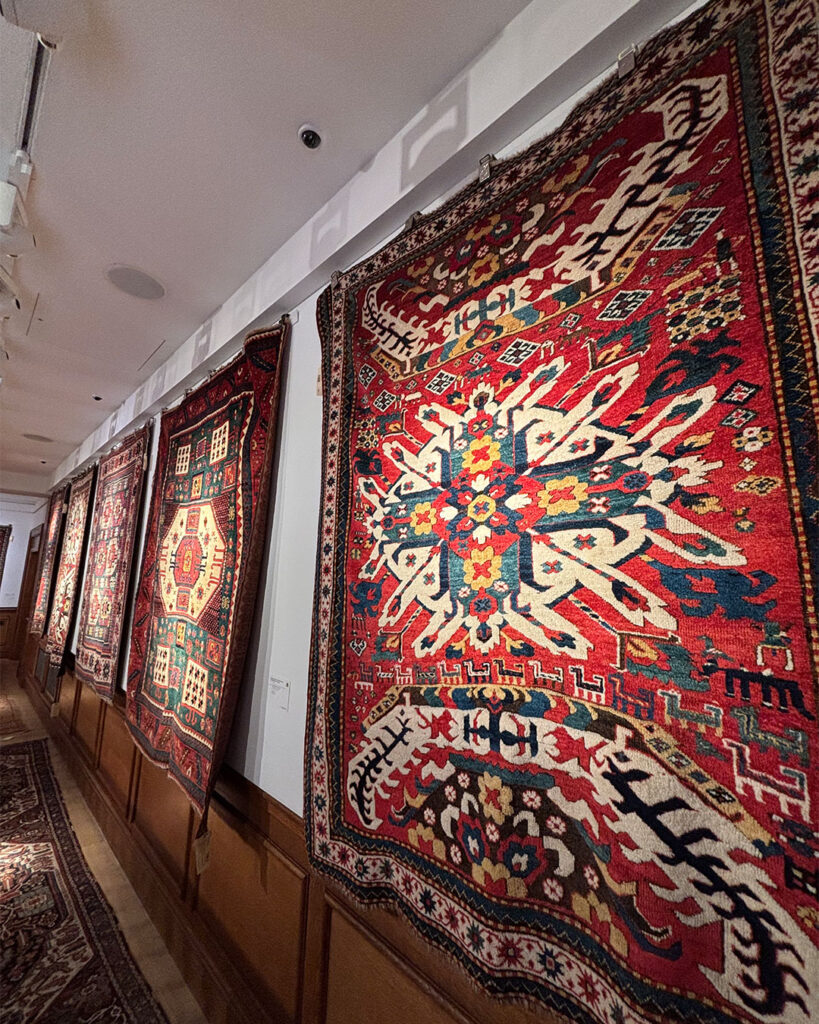
‘Art of the Islamic and Indian Worlds including Rugs and Carpets’, Christie’s, 30 April 2026
At Sotheby’s ‘Art of the Islamic World and India’ sale on 29 April, the Cairene Ottoman rug (Lot 200) from the second half of the 16th century achieved £166,400—more than four times its £25,000–35,000 estimate.
Given the high value attributed to classical period carpets in good condition and with good provenance, it is no real surprise that this well-known Cairene floral rug fetched more than four times its estimate. Once belonging to the great collector Hagop Kevorkian (1872-1962), it was included in the 1966 travelling loan exhibition of ‘The Kevorkian Foundation Collection of Rare and Magnificent Oriental Carpets’ (cat.no.32, unillustrated), before being bought by the New York dealer Dildarian at Sotheby’s memorable first Kevorkian auction in London on 5 December 1969, Lot 9, for £1,250. It eventually entered the collection of Lewis and Susan Manilow in Chicago, before returning to the market at Sotheby’s in New York on 7 April 1992, lot 86, when it made $66,000.
At the time (HALI 63, p.131) we wrote: ‘Perhaps the most astute observation in the rug’s [catalogue] description – we cannot tell whether it was due to Metropolitan Museum curator Maurice Dimand who wrote an introduction for the exhibition or to the unnamed Sotheby’s cataloguer – was that “the yellow flower head in the centre [was] surrounded by the herati design…”. Once one is aware of the connection it is not difficult to see the herati design transformed into a denser floral style. Little is known about the origin of this very successful Persian carpet pattern, or the source of its name, but it is rare to find it on Ottoman carpets of any period.’
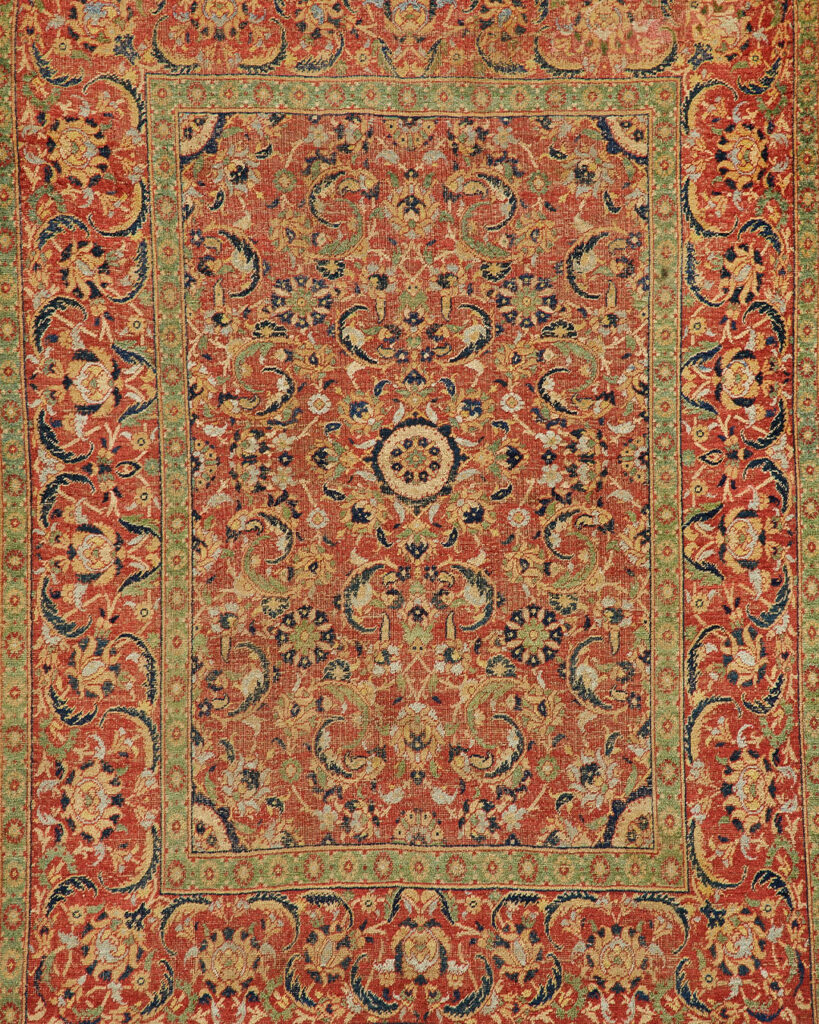
Cairene Ottoman rug, second half 16th century. Sotheby’s London, 29 April 2026, lot 200, estimate £25,000–35,000, sold for £166,400 ($224,650)
At Christie’s ‘Art of the Islamic and Indian Worlds including Rugs and Carpets’ sale on 30 April, the 17th-century Holms Hepburn ‘Coronation’ carpet (Lot 164) sold for £76,200.
An old friend, with royal connections that elevate it above the run of the mill, the Holms Hepburn Safavid ‘Coronation carpet’ was one of the most keenly contested of the rugs on offer, selling to an internet bidder in Thailand against bidders in the room and on the phone, for £76,200. A red-ground ‘in and out palmette’ design Safavid period weaving of the 17th century, perhaps Esfahan, but with an untypical cartouche border design, reconfigured into a squarish fragment, it was discussed by Thomas Farnham in HALI 164 (2010), when it belonged to St Mungo’s Cathedral in Glasgow, who consigned it to Lyon & Turnbull in Edinburgh on 25 June 2014 where it sold for £79,250 (HALI 180, p.135). It sold again at Sotheby’s in London on 19 October 2016, for £75,000 (HALI 191, p.119).
Now, a decade later, reconsigned to Christie’s in London, it again achieved a price between £75,000 and £80,000. Once with the well-known London firm of Duveen Brothers, and subsequently two Scottish private collectors, John Augustus Holms (1866-1938), and Charles A. Hepburn (1891-1971) who gifted it to the Glasgow cathedral in 1971, where it was placed over the tomb of the city’s patron saint. The ‘Coronation’ carpet moniker derives from the fact that it was loaned by Duveen for use at the coronations in Westminster Abbey of King Edward VII in 1902, and his son, King George V in 1911, as well as the marriage of Princess Mary in 1922.
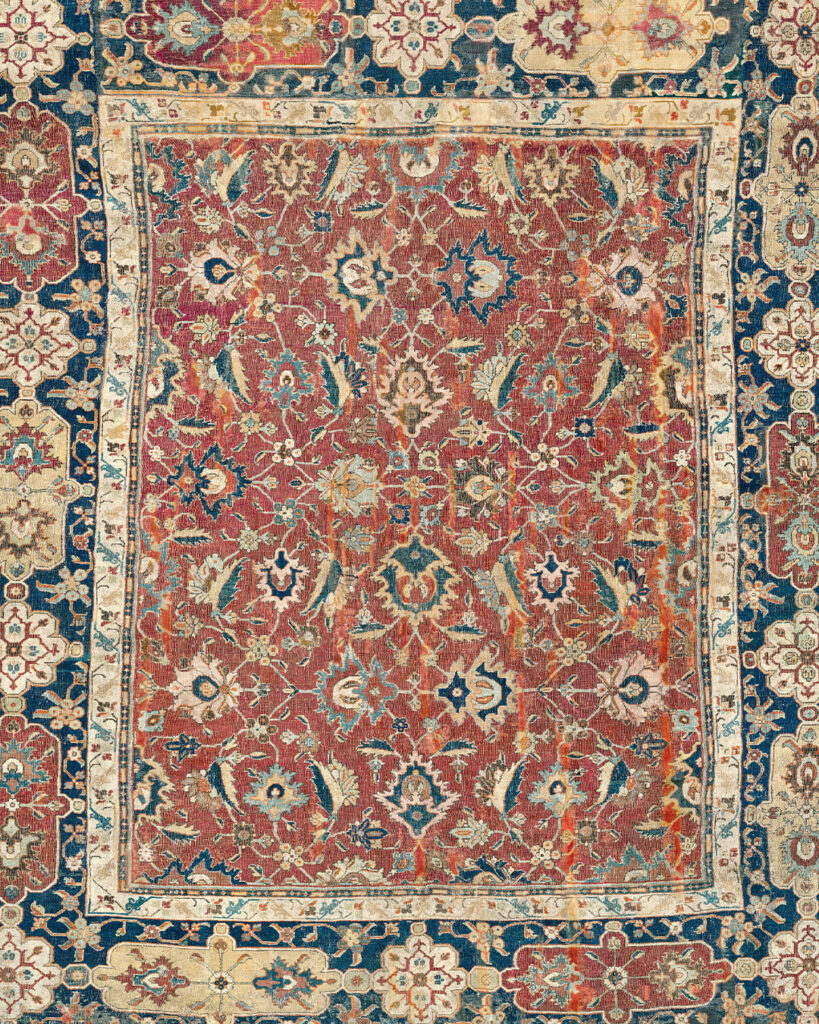
Holms Hepburn coronation carpet, probably Esfahan, central Persia, 17th century. Christie’s London, 30 April 2026, lot 164. Estimate £30,000–40,000, sold for £76,200